

Japanese methods of control, restraint and arrest adapted to police work.
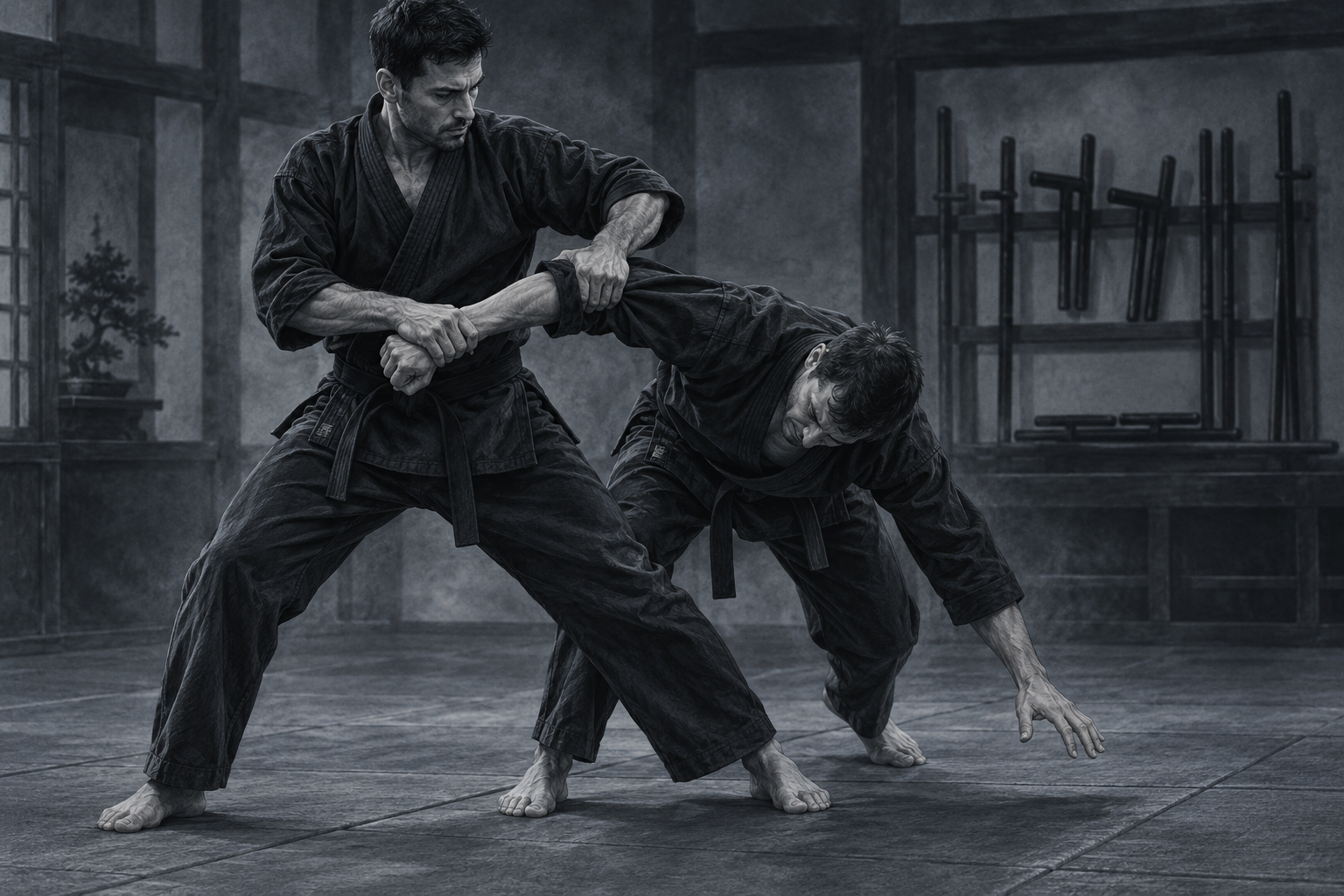
Taiho-jutsu is a Japanese method developed for specific police needs: protection, control, restraint and arrest while limiting injuries as far as possible.
Unlike competitive practices or those focused on knockouts, its main objective is controlling a situation. Training covers distance, movement, releases, grips, joint controls, off-balancing, throws and immobilisations.
The modern system drew on several Japanese traditions, including jujutsu, judo, karate, kendo and jojutsu, with some principles from Western boxing.
Practice may alternate unarmed work with control tools. Historically, Japanese police trained with various types of police baton. In modern adaptations and the founder's workshops, some exercises may also use the kubotan as a supplementary tool.
Techniques are studied progressively with partners: escaping a grip, obtaining control, off-balancing, guiding a person, immobilising or moving from resistance to a controlled position.
The aim is not to cause pain for its own sake, but to understand how positioning, leverage, movement and control can achieve an objective with the minimum necessary force.
Japanese arrest techniques are much older than modern Taiho-jutsu. Various jujutsu schools and martial traditions already included methods to control, capture or immobilise someone.
After the Second World War, Japanese police needed to adapt this knowledge to a new context. In 1947, a committee of specialists from several disciplines worked on a modern system designed for police needs.
Influences included Kodokan judo, jujutsu, Wado-ryu karate, kendo, jojutsu and Western boxing. The system developed into the modern Taiho-jutsu, meaning arrest techniques.
It is not fixed: methods have continued to evolve to meet the realities of police work.
Japan's National Police Agency still includes taiho-jutsu (逮捕術) in official police training, alongside disciplines such as judo and kendo.
Taiho-jutsu's central principle is not defeating an opponent but regaining control of a situation.
Effectiveness relies on observation, distance management, positioning, decisions, leverage and adapting responses to the resistance encountered.
Proportionality is essential: use enough force to gain control, but do not continue once control is established.
Practitioners must remain aware of their surroundings, other people nearby and how the situation changes.
In training, partners are indispensable. Controls should be studied realistically while protecting the people helping us learn.
This practice may interest people drawn to control, restraint and self-defence techniques rather than competition alone.
It explores grips, releases, throws, joint controls and immobilisations in situations where maintaining or regaining control is the main goal.
Its origin is professional and police-related. Adaptations for the public should not be confused with official law-enforcement training.
National Police Agency of Japan (NPA)
Taiho-jutsu / arrest techniques
Specialist historical sources on the system established in 1947.
