

Combat sport combining striking, takedowns, wrestling, ground control and submissions.
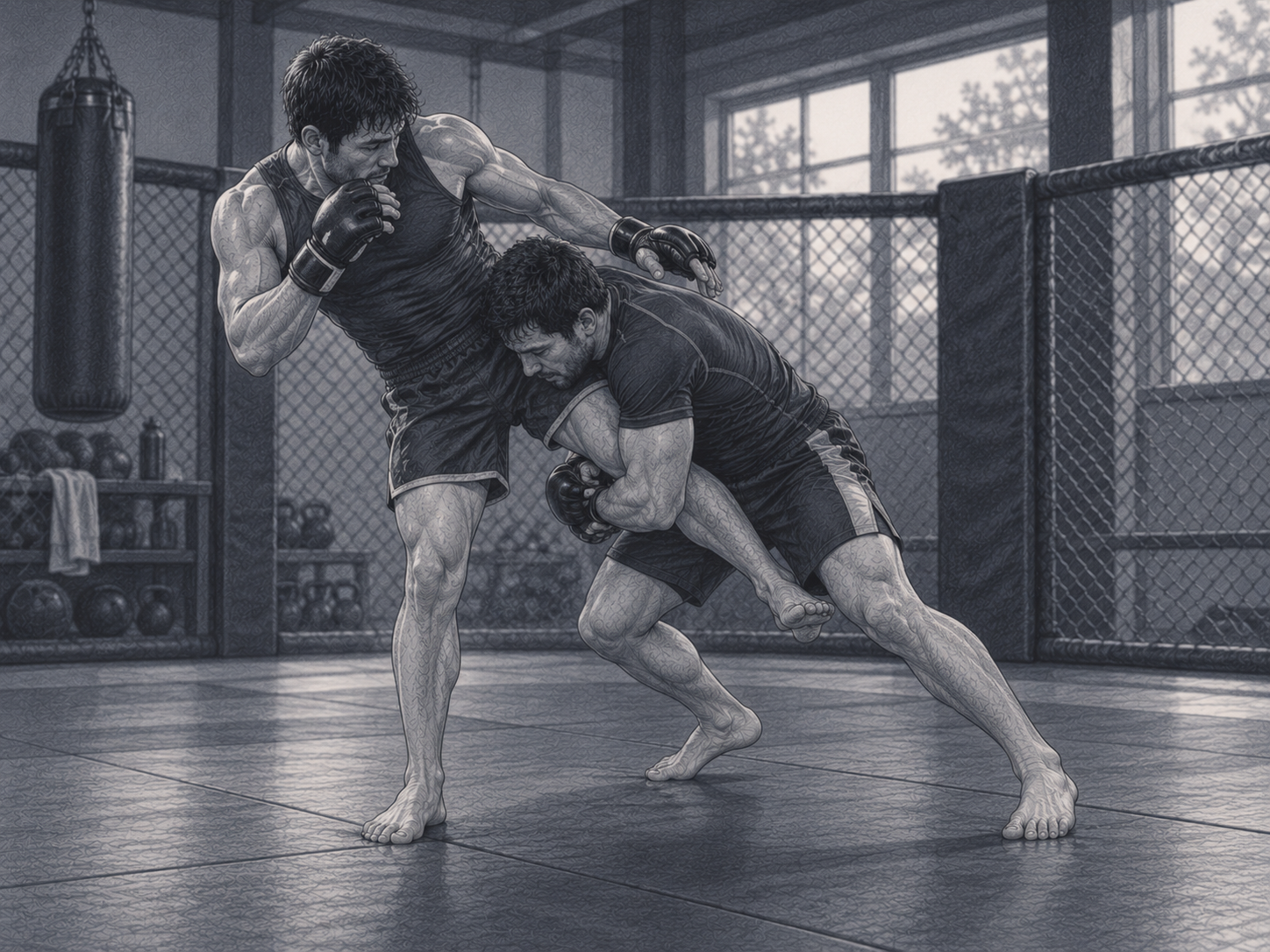
Mixed Martial Arts (MMA) is a combat sport that combines fighting at range, in the clinch and on the ground.
It integrates techniques from boxing, kickboxing, wrestling, judo, Brazilian jiu-jitsu and other combat disciplines. Over time, this combination developed its own techniques, strategies and training methods: MMA is now a discipline in its own right, not simply a succession of separate martial arts.
Standing exchanges use footwork, punches and kicks. Depending on the rules and level, other strikes may be allowed. At close range, practitioners use clinches, grips, wrestling, throws and takedowns.
Groundwork includes positional control, transitions, submissions and, where permitted, ground strikes.
A session may alternate striking, wrestling, throws, grappling and transitions. A central skill is moving naturally between ranges: striking, closing distance, taking down, controlling, standing up again or seeking a submission.
Cages are characteristic of many modern MMA competitions. They prevent competitors from leaving the fighting area and create specific technical situations involving wall control, defence and wrestling.
Training does not require fighting shirtless or inside a cage. Clothing and protective equipment depend on the exercise, experience level and applicable rules.
Fighting systems combining strikes and grappling existed in many cultures long before modern MMA.
In the 20th century, several currents contributed to modern mixed combat, notably Vale Tudo in Brazil, hybrid fighting formats in Japan and contests between practitioners from different disciplines.
The founding of the UFC in the United States in 1993 brought international attention to these cross-style contests. Fighters increasingly began training striking, wrestling and groundwork together rather than representing only one discipline.
The sport gradually developed more precise rules, weight classes, medical oversight and safety provisions. The Unified Rules of MMA became an important reference for professional competition during the 2000s.
In France, a major step came in 2020 when the French Boxing Federation received ministerial authority to officially oversee MMA. The FMMAF was established within FFBoxe to manage, regulate and develop the sport.
During the 1960s and 1970s, Bruce Lee developed Jeet Kune Do around ideas later associated with modern MMA: refusing to be confined to one style, studying different disciplines, adapting, pursuing effectiveness and developing a personal approach.
Bruce Lee was not the founder of modern MMA as a regulated sport, but his philosophy and technical approach anticipated several of its principles.
Modern MMA emerged through several strands, including Brazilian Vale Tudo, Japanese hybrid combat and encounters between practitioners from different backgrounds.
Since the UFC's emergence in 1993, competitors have increasingly trained striking, wrestling and ground fighting together.
Each practitioner can nevertheless build a different path, choosing the disciplines and methods that suit their goals and adapting what they learn. MMA is not proof that one martial art is superior to all others.
MMA may suit people who enjoy a broad combat practice and do not want to limit themselves to one fighting distance.
It brings together striking, wrestling, throws and groundwork.
It may particularly interest those curious about how different martial skills interact and how to transition between them.
Practice can be adapted to age, experience and level. In France, competition rules vary according to age, competitive class and level to support progressive development.
FMMAF / FFBoxe
IMMAF — International Mixed Martial Arts Federation
UFC and Bruce Lee Foundation — on the influence of Bruce Lee and Jeet Kune Do
