
Japanese martial art originating in Okinawa, focused on strikes, movement, formal sequences and, depending on the school, different forms of sparring.
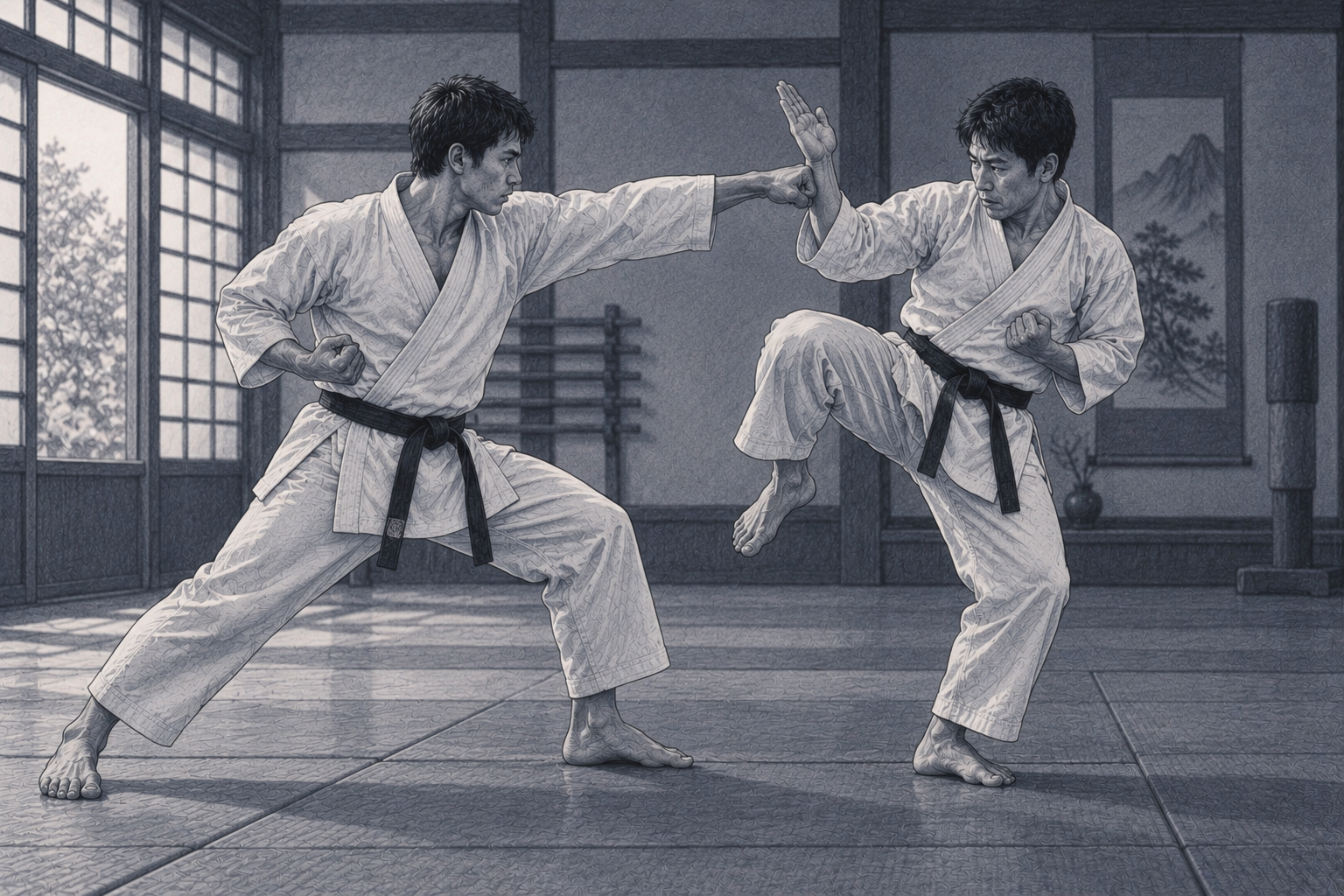
Karate-dō is a martial art developed in Okinawa and later spread throughout Japan and the rest of the world.
Training generally includes basic techniques (kihon), formal sequences (kata) and various forms of sparring (kumite).
Schools and styles differ greatly in the importance they give to competition, contact, traditional study, self-defence and technical development.
Modern karate developed in Okinawa from local practices and Chinese influences before being introduced more widely to Japan in the early 20th century.
Different masters and schools subsequently developed styles with sometimes very different methods, forms and sparring rules.
Karate-dō combines technical precision, posture, distance, timing, control and repetition. In many schools, the idea of dō also emphasises a path of sustained practice over time.
It would nevertheless be misleading to present a single philosophy: approaches vary by style, federation and teacher.
Karate can suit a wide range of people thanks to its varied schools: technical training, recreation, competition, more or less intensive contact, kata or martial exploration.
Fédération Française de Karaté (FFK)
World Karate Federation (WKF)
