
Japanese martial art founded by Jigoro Kano in 1882. Judo uses grips, off-balancing, throws and groundwork, while emphasising learning, control, mutual respect and efficient use of energy.
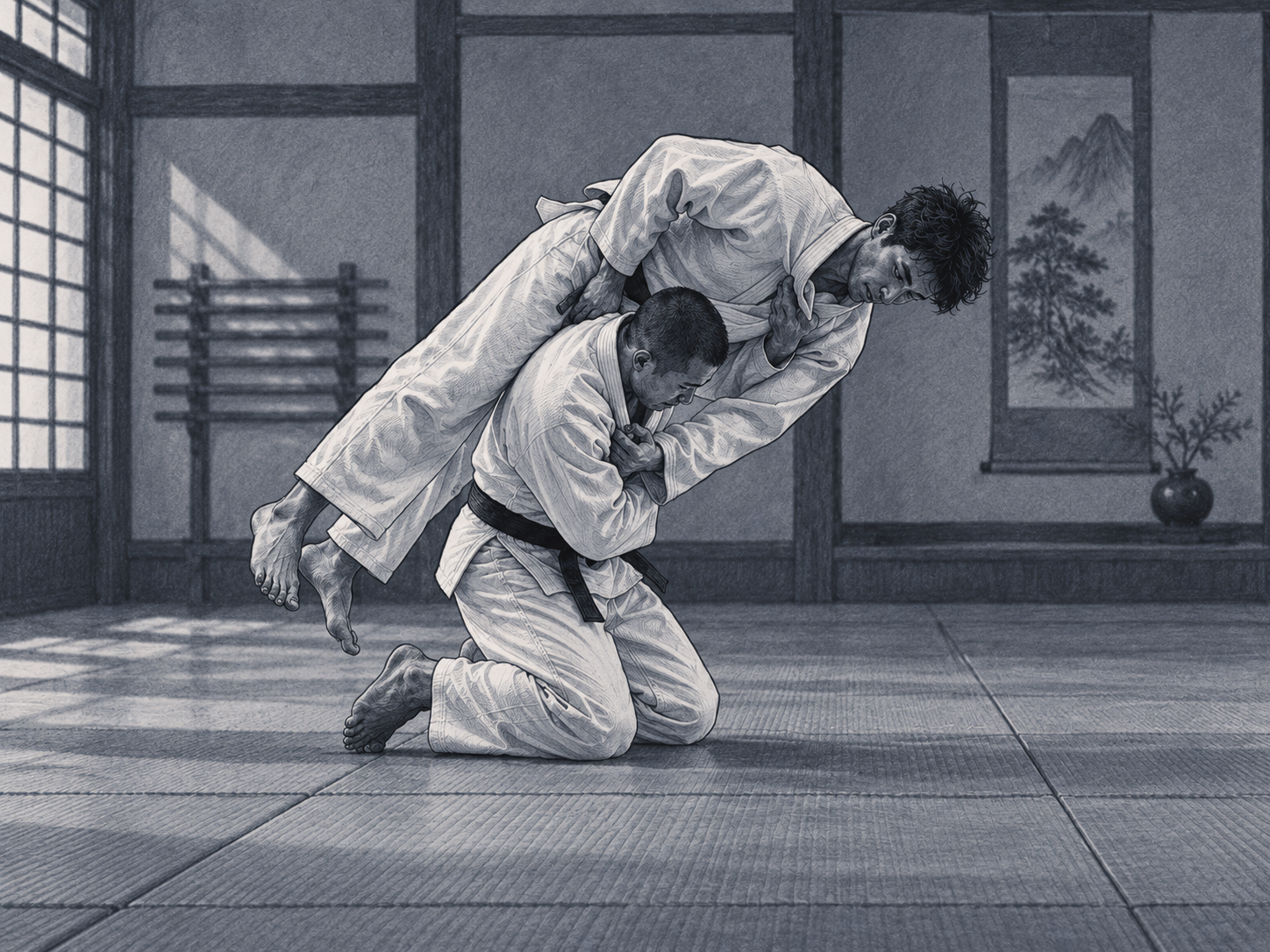
Judo is a Japanese martial art founded by Jigoro Kano in the late 19th century, drawing on his study of several traditional jujutsu schools.
Training is based on standing techniques and groundwork. Standing, judoka learn to grip, move, off-balance and use a partner's movement to perform throws. On the ground, they practise pins and, depending on age and rules, certain chokes and joint locks.
Judo is not simply about strength: positioning, balance, timing, adaptation and using a partner's movement are essential.
Training also includes learning how to fall safely (ukemi), free practice with a partner (randori) and kata, which preserve and explore technical forms.
Partners make practice, experimentation and progress possible. Control and respect are therefore integral to learning.
Jigoro Kano (1860–1938) studied several schools of jujutsu in his youth. He sought to preserve their principles while developing a method that could contribute to physical, intellectual and moral education.
In 1882, aged 22, he founded the Kodokan in Tokyo. He synthesised jujutsu traditions and removed or adapted some dangerous techniques to allow regular partner training. Judo later spread through Japanese schools, universities and institutions before reaching other countries.
For Kano, judo was more than fighting. Two key principles were Seiryoku Zenyo, the most efficient use of energy, and Jita Kyoei, mutual welfare and benefit.
Judo became an international sport during the 20th century. Men's judo entered the Olympic programme in Tokyo in 1964, while its martial, educational and cultural dimensions continued beyond competition.
Judo teaches that effectiveness comes not only from strength but from using balance, movement, positioning and energy wisely.
Kano linked technical progress to education: individual improvement should also help others progress.
Respect for partners is essential. Learning to throw also means learning to fall; attacking requires control; progress depends on a trustworthy training partner.
Seiryoku Zenyo — making the best use of energy. Jita Kyoei — mutual welfare and benefit through cooperation.
Judo can be practised in different ways according to age, ability and goals: early childhood discovery, technical study, recreation, physical training, competition or martial exploration.
It may particularly suit people who enjoy contact, partner work, throws, body control, off-balancing and groundwork, without strikes in ordinary sporting practice.
www.ffjudo.com
www.ijf.org
Kodokan Judo Institute
