

Family of Japanese fighting practices including, depending on the school, grips, throws, joint controls, pins, strikes and sometimes weapons.
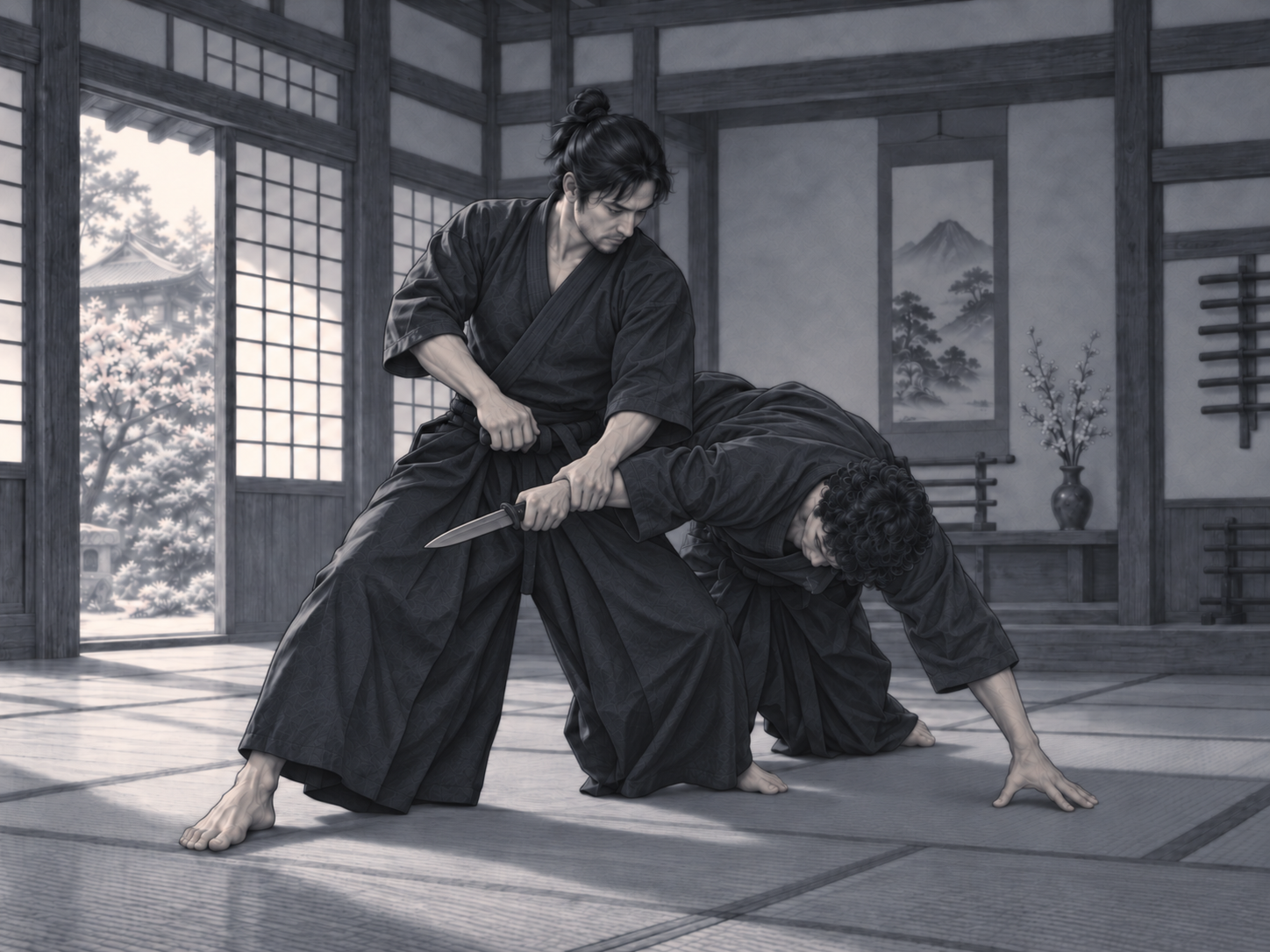
Traditional ju-jutsu describes a family of Japanese martial systems rather than one uniform method.
Depending on the school, practice may combine throws, off-balancing, joint controls, pins, chokes, strikes, defences against grips and sometimes weapons.
This diversity reflects the history of jujutsu: different schools developed methods for different contexts and goals.
Jujutsu traditions developed over centuries in Japan within martial schools with varied methods. They influenced many modern arts, notably judo and, indirectly, Brazilian Jiu-jitsu.
Today, 'traditional ju-jutsu' can refer to historical lineages, modern schools or syntheses seeking to retain a wider practice than competition alone.
A principle often associated with jujutsu is using positioning, off-balancing, leverage and adaptation rather than directly opposing strength with strength.
Aims and philosophies vary between schools. Identifying the teacher and lineage is important when seeking to understand a particular practice.
Traditional ju-jutsu may appeal to people seeking a varied practice combining different fighting distances and technical families, with an interest in martial heritage and technical transmission.
Historical sources on Japanese jujutsu traditions.
Specific content should be documented according to the school or lineage presented.
