

Japanese martial art combining, depending on the school, strikes, throws, joint controls and groundwork.
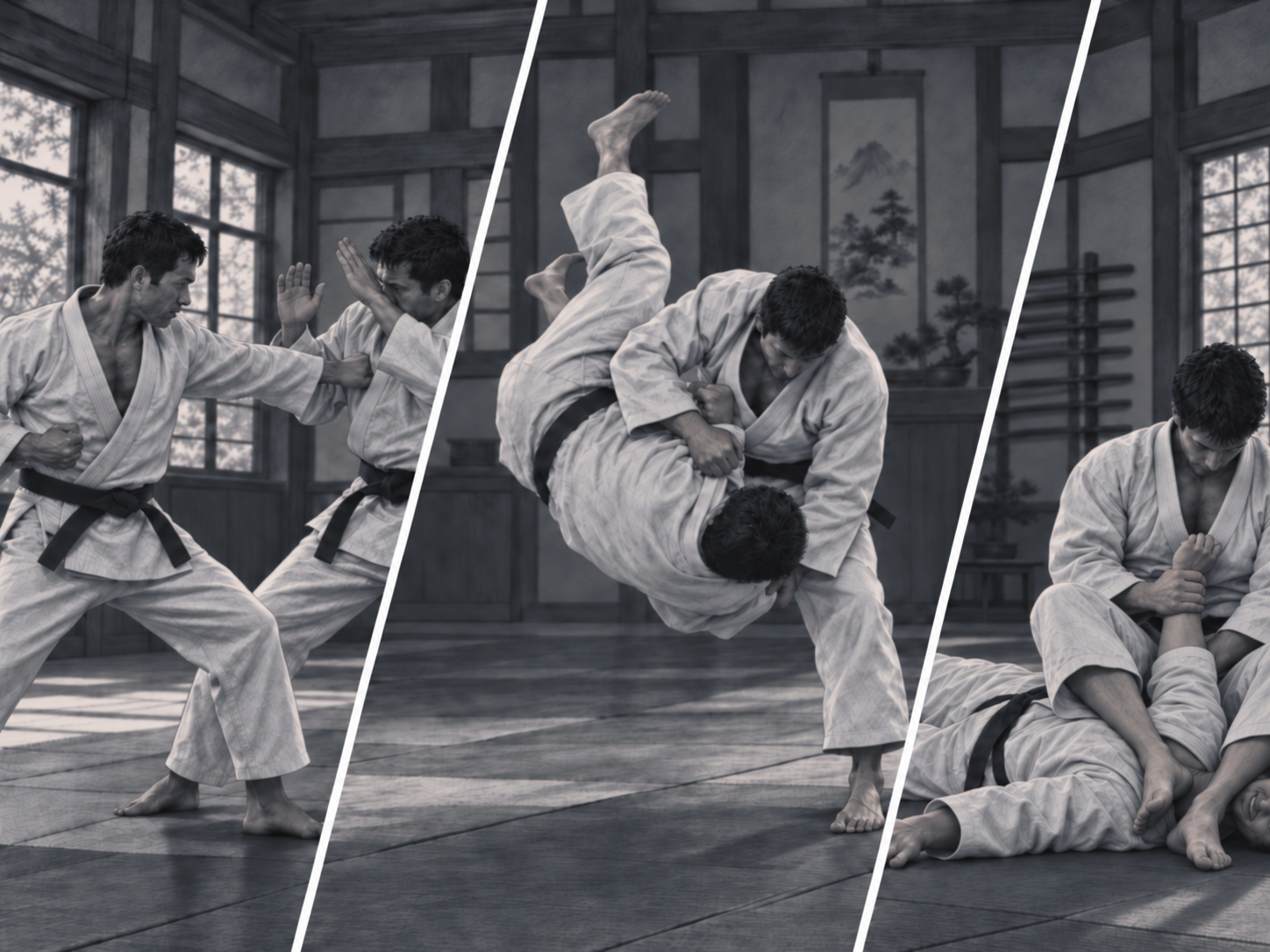
Japanese jiu-jitsu or jujutsu refers to a family of fighting methods developed in Japan around adaptation, control and using an opponent's force.
Depending on the form, training may include evasions, movement, punches or kicks, grips, joint locks, off-balancing, throws, pins, chokes and groundwork.
Jujutsu often connects phases of combat: acting at range, closing distance, gripping or off-balancing, throwing and controlling on the ground.
The sporting form developed by France Judo, Jujitsu Fighting (also called Jujitsu Combat), illustrates this continuity. Competition has three parts: controlled strikes at range, grips and throws, then groundwork with pins and submissions. Practitioners transition between these phases during a bout.
Traditional training may be more technical and progressive, using defined attacks and responses. The Duo System is one sporting expression of this work.
Sessions vary from technical learning and partner drills to set scenarios, progressive resistance and freer sparring. Control and partner safety remain essential.
Jujutsu has no single founder. Historically, the term describes various Japanese schools and methods, including ways to control an opponent when a weapon was unavailable or unsuitable.
These systems included throws, controls, locks, chokes and strikes and evolved over time in many schools.
In the late 19th century, Jigoro Kano studied Tenjin Shinyo-ryu and Kito-ryu jujutsu, among others. In 1882 he adapted techniques to establish Kodokan Judo, seeking safer training and education. The Kodokan acknowledges judo's origins in older jujutsu traditions.
Judo and jujitsu have long been linked in France. The French Judo and Jiu-jitsu Federation was founded in 1946. French jujitsu later developed traditional, technical, self-defence and competitive forms.
From the 1990s, international competition expanded through the Fighting and Duo Systems. France Judo now recognises several expressions of jujitsu within the same family.
Jujitsu emphasises adaptation rather than one fixed response.
Practitioners learn to observe situations, manage distance, move, exploit imbalance, control a limb and change their actions when circumstances change.
This develops transitions from strikes to grips, grips to throws and throws to ground control.
Effectiveness is not maximum violence. In training, techniques should be accurate while retaining control to protect partners.
Partners help practitioners understand distance, timing, resistance, reactions and the limits of techniques.
Jujitsu may suit people seeking a versatile practice that explores several fighting distances rather than specialising immediately.
It combines striking, grips, throws, standing work and groundwork.
Depending on the club, it may be taught traditionally, technically, recreationally, for self-defence or competitively.
It can also introduce skills later explored through judo, Brazilian jiu-jitsu, striking sports or other combat systems.
France Judo / FFJDA
Kodokan Judo Institute
Ju-Jitsu International Federation (JJIF)
