

Martial art and combat sport developed in Brazil from Japanese judo and jujutsu. It emphasises ground control, positional reversals and submissions, in gi or no-gi training.
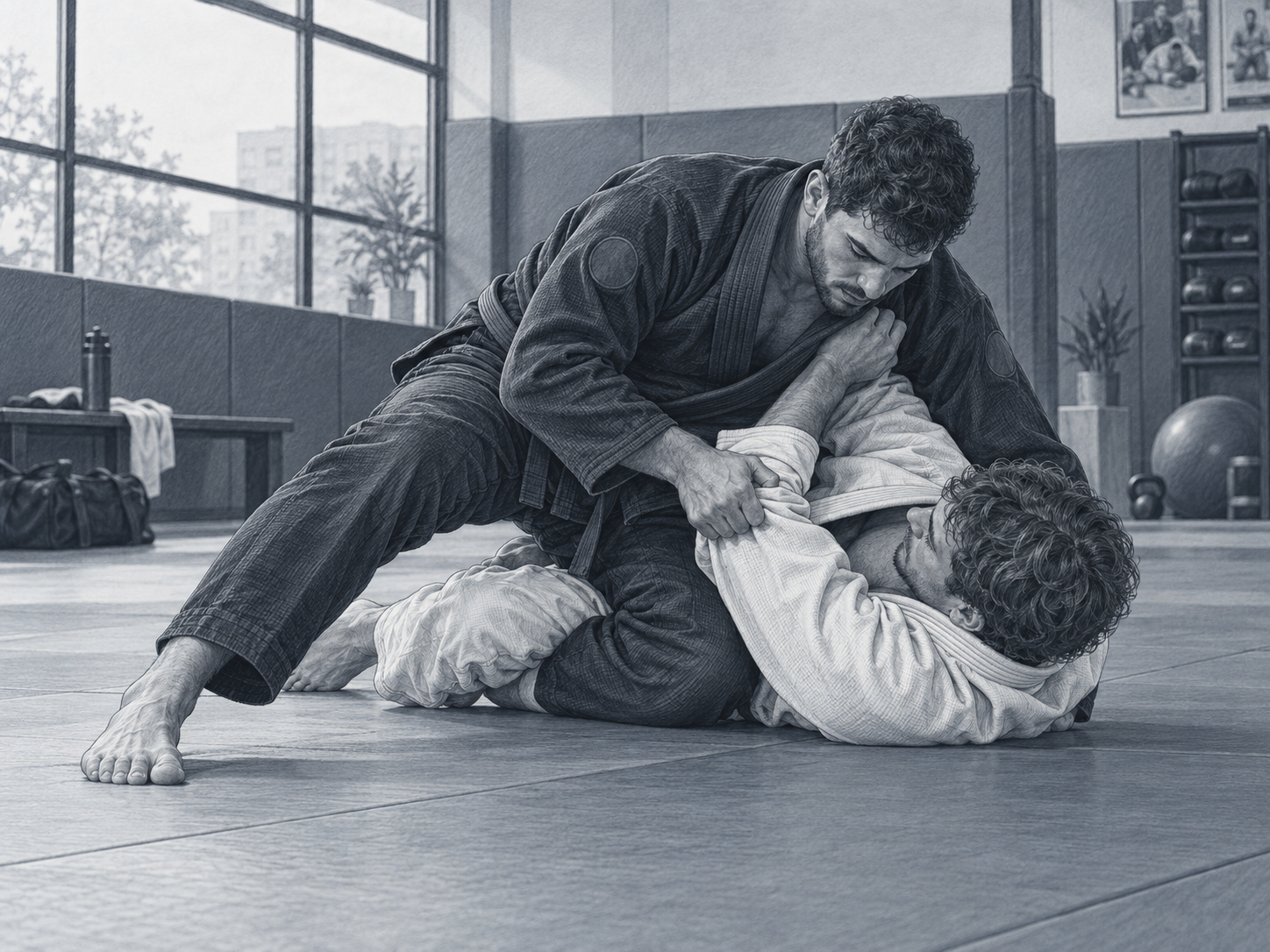
Brazilian Jiu-jitsu (BJJ) is a martial art and combat sport with a particular emphasis on groundwork.
Practitioners learn to control a partner, improve position, reverse an unfavourable situation and seek submissions, including chokes and joint locks.
Positioning, leverage, timing, mobility and reading a partner's reactions are central. Strength can help but does not replace technique or efficient body use.
Training covers takedowns, guards, guard passes, sweeps, positional control, pins and submissions.
Sessions commonly begin with a warm-up and mobility, followed by technical study of positions, movement, controls and partner techniques. Movements are introduced progressively and tested against increasing resistance.
Situational training involves holding or escaping a position, sweeping, passing a guard or finding a submission.
Sessions often include free sparring, commonly called rolls, where both partners resist and pursue their own strategies.
Safety requires technical control, attention to partners and respect for submission signals. When someone taps or verbally submits, the technique must be released immediately.
BJJ is practised both in a gi (jacket and trousers) and without a gi, typically in a rashguard and shorts. The principles are related, but clothing changes grips, control and strategy.
Brazilian Jiu-jitsu draws significantly on Kodokan judo and Japanese fighting arts introduced to Brazil in the early 20th century.
Mitsuyo Maeda, a judoka trained at Jigoro Kano's Kodokan, is a central figure. After travelling and taking part in bouts and demonstrations, he settled in Brazil and shared his experience of judo and fighting. France Judo identifies him as important to BJJ's development.
This transmission was developed in Brazil, notably by members of the Gracie family and other practitioners, with growing emphasis on groundwork, control and submissions.
Throughout the 20th century, BJJ evolved as a fighting method, self-defence system and competitive sport. Its international expansion accelerated towards the end of the century.
Today numerous international organisations and circuits exist. In France, France Judo has developed a national Brazilian Jiu-jitsu circuit since 2026, currently in a gi format.
Brazilian Jiu-jitsu emphasises control rather than relying on brute strength.
Practitioners use positioning, base, leverage and timing to manage a resisting partner who is also trying to impose their own game.
Being in a bad position does not necessarily mean defeat. Much of the learning involves staying calm, understanding the situation, defending, creating space and gradually improving position.
Partners provide realistic resistance and help reveal the limits of techniques. This progressive resistance distinguishes BJJ from purely choreographed practice.
Respect and control are essential: submissions should be applied precisely and released immediately when a partner taps or submits.
BJJ may suit people who enjoy groundwork, technical problem-solving, strategy and physical contact with partners.
It can be practised recreationally, competitively, alongside other martial arts or to improve fitness, mobility, coordination and adaptability.
Body type and physical strengths may influence a person's style, but the variety of positions and strategies allows individuals to develop their own approach.
BJJ can be practised at different ages and levels provided teaching, permitted techniques and intensity are adapted to participants.
France Judo / FFJDA
International Brazilian Jiu-Jitsu Federation (IBJJF)
