

Combat sport using foil, épée or sabre, developing speed, precision, distance, timing, strategy and the ability to score a touch while avoiding being hit.
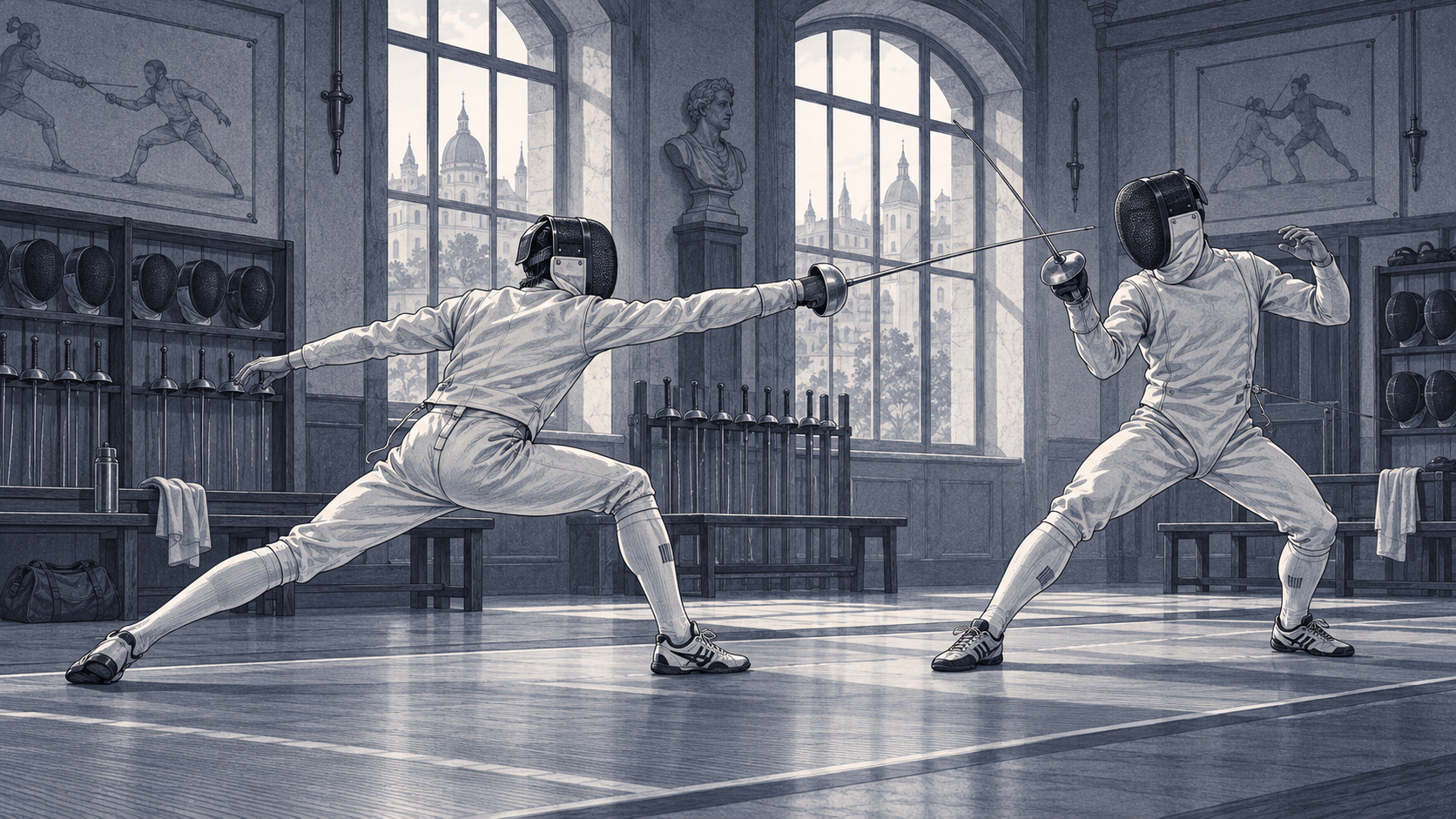
Sport fencing is a codified duel between two fencers using one of three weapons on a piste.
The three weapons are foil, épée and sabre.
Foil scores with the point only. The valid target is mainly the torso, and priority (right-of-way) rules apply.
Épée also scores with the point, but the entire body is a valid target. There is no comparable priority rule, and both fencers may score simultaneously in some situations.
Sabre permits touches with the point and the edge of the blade. The valid target is mainly the upper body, and priority rules also apply.
In modern competition, electrical scoring equipment records touches. Bouts take place on a piste, under specific rules for movement, boundaries, valid touches and penalties.
Fencing combines physical and mental skills: reaction speed, explosive movement, balance, precision, reading an opponent and very rapid decision-making.
Bladed combat has existed since antiquity, but modern sport fencing developed through a long transformation of European duelling and weapons instruction.
From the Renaissance, organised fencing schools developed notably in Spain, Italy and France. As weapons, protective equipment and social customs changed, fencing gradually evolved from real combat into training and then regulated sport.
During the 19th century, sporting practice expanded. Weapons became more suitable for training, rules were standardised and competitions developed.
Fencing was included in the first modern Olympic Games in Athens in 1896, initially with foil and sabre. Épée entered the Olympic programme in 1900.
The International Fencing Federation (FIE) was founded in Paris in 1913, notably to unify international rules, and remains the international governing body for sport fencing.
Electrical scoring progressively transformed competition in the 20th century, first in épée and later in foil and sabre.
Today, women and men practise all three weapons recreationally and competitively, up to the highest international level.
Fencing is built around the idea of touching without being touched.
This requires simultaneous management of distance, rhythm, initiative and an opponent's reactions.
Distance is fundamental: too close may expose you to an attack, while too far away makes your own action ineffective.
Fencers learn to provoke reactions, disguise intentions, vary rhythm and exploit an opponent's mistake.
Speed alone is not enough. Tactics, observation, anticipation and split-second decisions are central.
Modern sport fencing also requires respect for opponents, referees, rules and safety.
Sport fencing may appeal to people interested in a highly technical, fast and strategic duel.
It develops reaction speed, coordination, precision, distance management, explosive footwork, strategy and anticipation.
The three weapons feel different: foil rewards precision and convention, épée offers the whole body as a target and a different tactical approach, while sabre is particularly fast.
Fencing can begin in childhood and continue into adulthood, recreationally or competitively.
International Fencing Federation (FIE) — general history and development of international sport fencing.
FIE — official rules and documents — the three weapons, competitions and equipment.
French Fencing Federation (FFE) — fencing organisation and practice in France.
Royal Spanish Fencing Federation (RFEE) — organisation, competitions and training in Spain.
Italian Fencing Federation (FIS) — history of the Italian school and development of sport fencing.
