

Japanese martial sport created in 1971 by Tetsundo Tanabe. It uses soft, padded weapons to develop distance, precision, movement, decision-making and control in an accessible, playful practice.
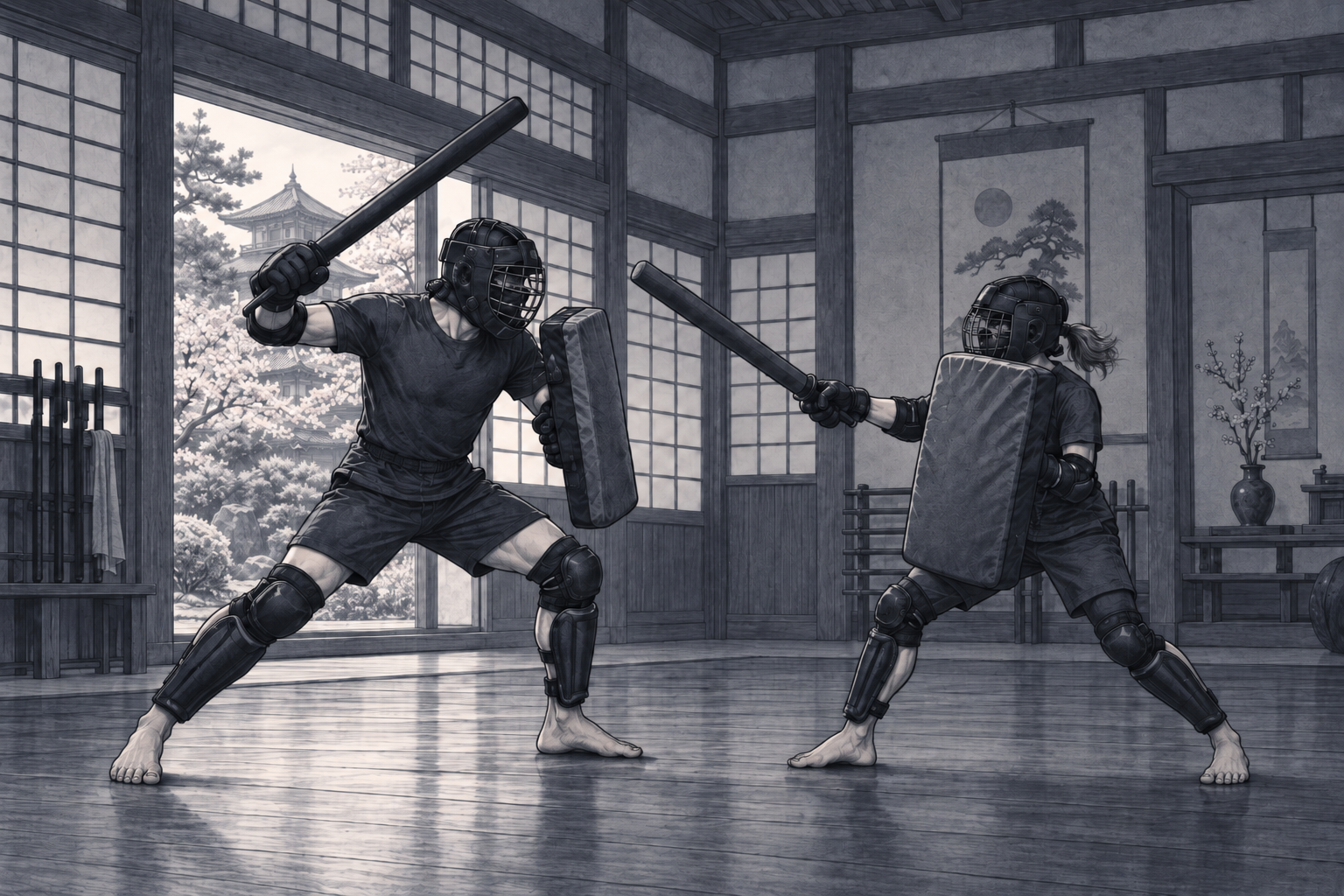
Sport Chanbara is a Japanese martial sport based on combat with soft, padded training weapons.
It allows considerable freedom of movement and weapon use. Practitioners learn to manage distance, observe partners, move, attack, evade, defend and choose the right moment to act.
Different weapons change the nature of combat: the short sword (kodachi), long sword (choken), two swords (nito), spear (yari) and others depending on level and training context.
This variety develops different ranges, stances, speeds and strategies without relying on raw power.
Adapted weapons allow dynamic exchanges while maintaining control and safety.
Training may begin with footwork, stances, weapon handling and striking trajectories. Students then practise range, attacks, defence, evasions and counters with partners.
Exercises can be technical drills, set scenarios or freer bouts. Sporting competitions may distinguish basic technical work (kihon dosa) from combat (datotsu).
Helmets and appropriate equipment allow committed practice while keeping exchanges controlled.
Sport Chanbara originated in Japan in 1971 through Tetsundo Tanabe, a practitioner and teacher of defensive techniques.
He wanted to revive a freer and more spontaneous form of sword combat while developing equipment that allowed safer practice. The first organisations developed in Japan in the early 1970s before the discipline spread abroad.
In France, its development began in 1994 when four kendoka — Kenichi Yoshimura, Claude Hamot, Claude Pruvost and Jean-Claude Girot — founded the French Sport Chanbara Association. In 1998 it was officially integrated into the National Kendo Committee of the FFJDA.
Today Sport Chanbara is practised within the network associated with France Judo and the National Kendo and Related Disciplines Committee.
Practice involves both the ability to score a touch and the ability to control one's actions and honestly acknowledge what happened in an exchange.
Distance, timing, observation, adaptation and decision-making often matter more than physical strength.
Partners are essential: they allow students to test choices, positioning and reactions in dynamic situations.
In Tanabe's approach, honesty towards oneself and one's opponent is important. Acknowledging a received touch and respecting partners are part of learning.
Sport Chanbara may suit children and adults and can be practised playfully, educationally, martially or competitively.
It may appeal to people who enjoy movement, strategy, games of opposition and distance work, or who want to explore weapons combat without immediately entering a more rigidly codified sword discipline.
The range of weapons and situations allows practice to be adapted to different physical profiles and skill levels.
Comité National de Kendo et Disciplines Rattachées (CNKDR)
France Judo / FFJDA
International Sports Chanbara Association (ISCA)
