
Traditional unarmed martial art from Myanmar, developing footwork, defence, counterattacks, striking, control and adaptability. It belongs to the Thaing traditions alongside Banshay, Naban and Lethwei.
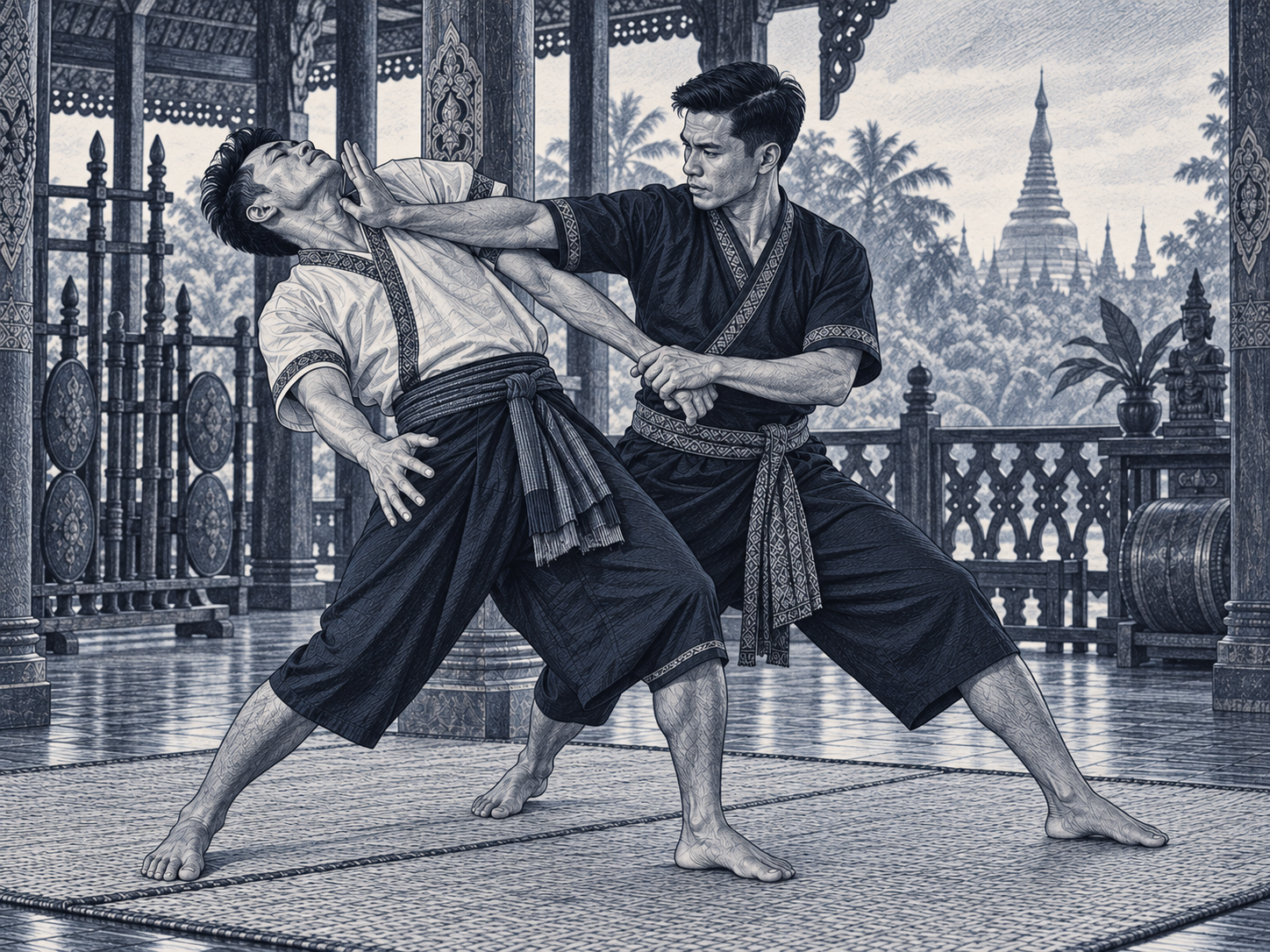
Bando is a Burmese unarmed martial art based on adaptation, movement, defence and counterattack.
Training develops mobility, distance management, changing angles, evasions, defensive actions, strikes, combinations and different forms of control.
The aim is not simply to learn isolated techniques. Practitioners gradually learn to position themselves, protect their bodies, avoid or redirect attacks and respond appropriately.
Sessions may include individual exercises, technical forms, partner work, martial applications and controlled exchanges. Some schools also offer sporting or competitive formats, depending on level and national context.
Bando uses the body's natural striking tools and works at several ranges. It is distinct from Lethwei (traditional Burmese boxing), Naban (wrestling and grappling) and Banshay (traditional weapons).
Some lineages, notably Hanthawaddy Bando, use animal-inspired systems. These are not merely imitation: each emphasises different movement, defensive, offensive and adaptive strategies.
Myanmar's martial traditions are old and diverse, and cannot be reduced to a single origin or lineage.
Thaing is now used for a broader family of Burmese martial traditions. In contemporary organisations, Bando mainly refers to unarmed practice, while Lethwei, Naban and Banshay have distinct identities.
An important stage in Bando's modern history followed the Second World War. U Ba Than Gyi helped collect, organise and systematise different Burmese martial teachings. In the late 1940s and early 1950s, this contributed to the organisation of Hanthawaddy Bando.
Hanthawaddy Bando does not represent all of Bando or all Burmese martial arts; it is one lineage or organised system within a wider heritage.
His son U Maung Gyi played an important role in bringing Bando to the United States. He introduced a form of the system in Washington in 1960 and later helped develop the American Bando Association.
Organised Bando practice in France is documented in Grenoble from 1986, leading to the creation in 2008 of the National Federation of Bando, Lethwei and Associated Disciplines.
Since 23 September 2026, Thaing — including Bando, Banshay and Naban — and Lethwei have been included in the French Karate and Associated Disciplines Federation, within a group dedicated to Myanmar martial arts and combat sports.
Adaptation is one of Bando's central principles.
Rather than applying one response to every situation, practitioners learn to adjust according to distance, angle, movement and a partner's actions.
Movement is essential: evading an attack line, changing angles or controlling distance may matter as much as striking.
Defence and counterattack are linked. The aim is not only to block but to regain a favourable position and initiative.
Training develops coordination, balance, accuracy, control and readiness as circumstances change.
In some lineages, animal-inspired systems provide another way to explore tactical and physical strategies such as mobility, power, evasion, pressure and changes of level.
Bando may suit people seeking a varied unarmed martial art focused on defence, movement and adaptation.
It may appeal to those interested in self-defence beyond striking alone, using evasions and positioning, exploring a less widely known Southeast Asian martial tradition, or practising technically and traditionally while retaining the possibility of controlled opposition or competition.
Content and intensity differ between schools. Someone seeking primarily full-contact striking may find a more specific approach in Lethwei.
French Karate and Associated Disciplines Federation (FFK) — current French federation framework for Myanmar martial arts and combat sports.
Union Française de Lethwei & Bando (UFLB / FNBL&DA) — disciplines, technical standards and development in France.
World Bando Thaing Lethwei Federation (WBTLF) — international framework and Bando overview.
American Bando Association — documentation on Hanthawaddy Bando, U Ba Than Gyi and U Maung Gyi.
