

Japanese martial art based on movement, off-balancing, throws and joint controls.
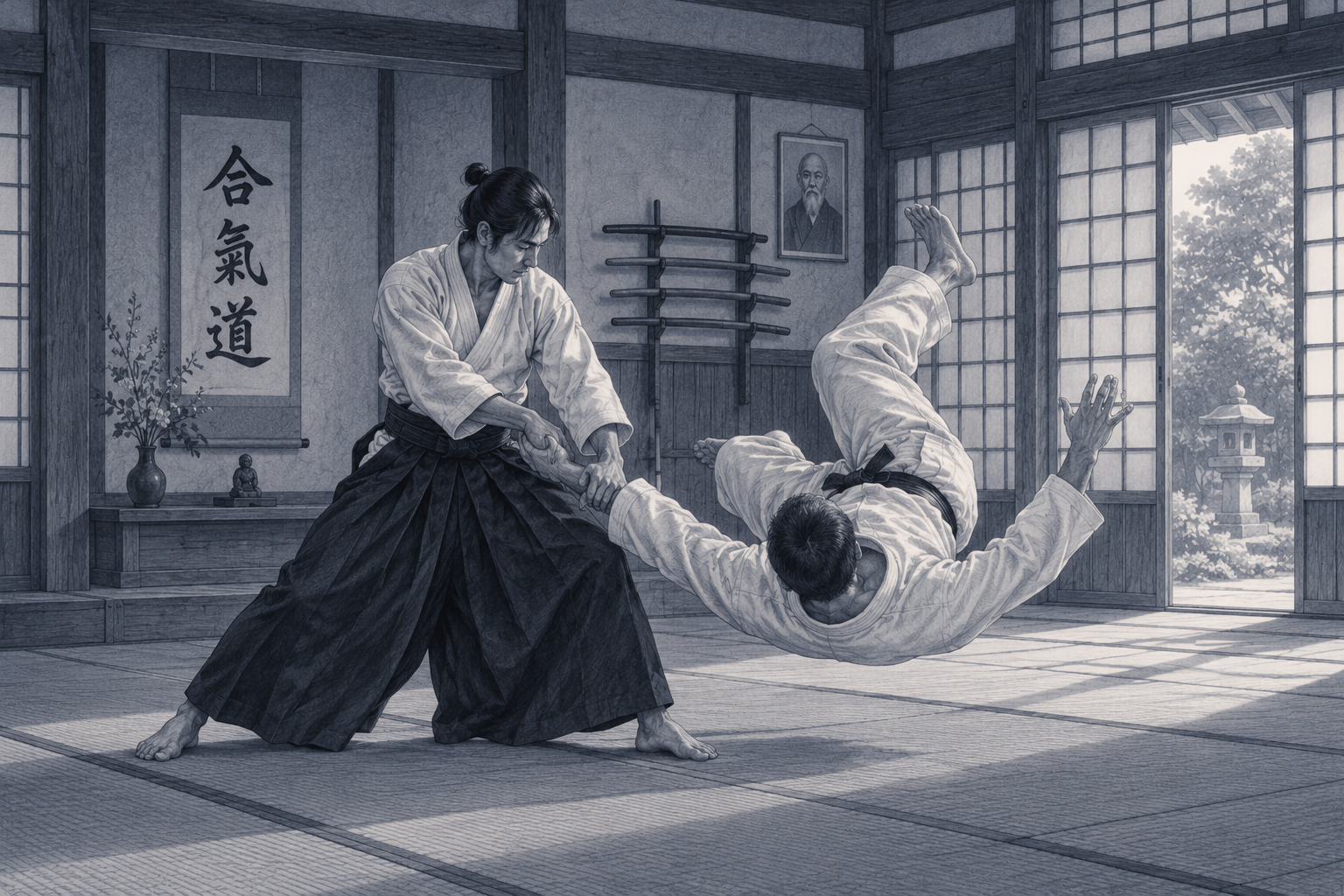
Aikido is a Japanese martial art developed by Morihei Ueshiba from his experience of several Japanese martial traditions.
Practice is based on movement, distance management, off-balancing and making use of a partner's motion. Instead of directly opposing force with force, practitioners seek to redirect, accompany or transform an incoming action.
Techniques include throws, joint controls, pins and circular movements. Much of the training starts from grips or attacks that allow students to study positioning, timing and direction.
Sessions generally include footwork, falling practice (ukemi) and progressive technical work with partners. The person receiving a technique learns to move and fall safely, just as the person applying it learns to control the throw.
Some schools train with wooden practice weapons, notably bokken, jo and tanto, to study distances, trajectories and principles that also appear in unarmed techniques.
Aikido is generally not competition-based. Progress comes through repetition, partner study and increasingly precise, fluid movement.
Morihei Ueshiba was born in Japan in 1883 and studied several traditional martial arts in his youth. His technical and spiritual exploration gradually led him to develop a personal approach to budo.
In 1920 he opened an early dojo in Ayabe. Over the following years his teaching evolved around the idea of aiki. He later moved to Tokyo and opened the Kobukan Dojo in 1931.
The name Aikido was officially adopted in 1942. After the Second World War, Aikikai and many of Ueshiba's students helped spread Aikido throughout Japan and internationally.
Ueshiba died in 1969. His son Kisshomaru Ueshiba continued its international development, and Moriteru Ueshiba became the third Doshu in the late 1990s.
Aikido seeks to avoid direct opposition, using movement, off-balancing and the direction of force rather than muscular strength alone.
A partner is more than an opponent: both participants are essential to learning. One practises accurate, controlled techniques while the other learns to receive movement, maintain balance when possible and fall without injury.
Training develops mobility, sensitivity to partners, control, timing and readiness to adapt when circumstances change.
In Ueshiba's teaching, Aikido extends beyond technical effectiveness: budo becomes a way to work on oneself and one's relationship with others. The French Aikido federation FFAB likewise presents it as a budo not simply aimed at defeating an opponent.
Aikido may appeal to people who enjoy technical study, circular movements, throws and controls without necessarily seeking competition.
It can also suit those wishing to develop balance, mobility, coordination, falling skills, distance management and partner work.
Practice can vary greatly by instructor, school, age and individual goals.
Aikikai Foundation
FFAB / Fédération Française d’Aïkido et de Budo.
